Abstract
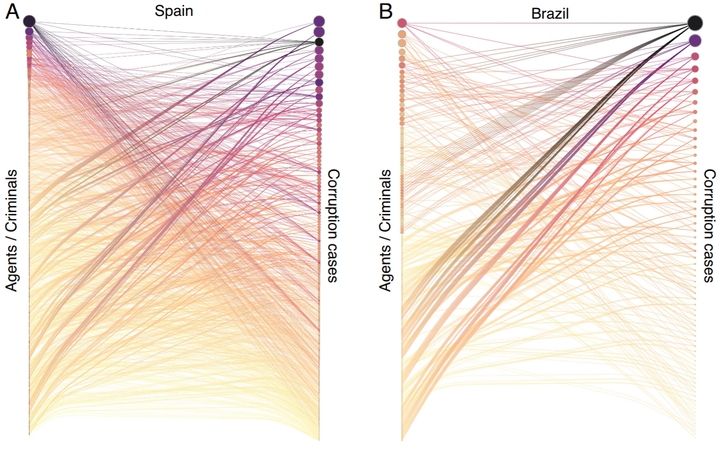
Political corruption is inherently an affiliation process linking agents to corruption cases; yet it is often studied via one-mode projections that connect co-offenders within the same scandal, implying a loss of information that potentially confounds properties of agents and cases. Here, we adopt a bipartite representation to analyze datasets of corruption scandals in Brazil and Spain spanning nearly three decades. By tracking the temporal growth of these networks, we quantify density and redundancy measures to capture partner reuse and co-occurrence across cases. Networks in both countries become progressively sparser over time, and agent redundancy is systematically higher than case redundancy, indicating a small cadre of recidivists who recombine largely with novice partners rather than forming durable co-offending ties. These networks exhibit near-exponential degree distributions, reflecting low recidivism and likely high coordination costs and secrecy constraints of large-scale scandals. Our bipartite view further reveals a moderate cross-mode disassortative degree mixing between agents and cases, with high-degree agents distributing their activity across small cases and large scandals mainly comprising low-degree participants. Finally, identifying atypical individuals within the bipartite structure reveals criminal trajectories marked by a gradual rise in network embeddedness that can appear ordinary in agent-projected networks.

Mônica Valério Prates
Ph.D. student

Arthur Augusto Barizon Pessa
Assistant Professor