Charting the life of Billboard hits through memory, turnover, and predictability
Abstract
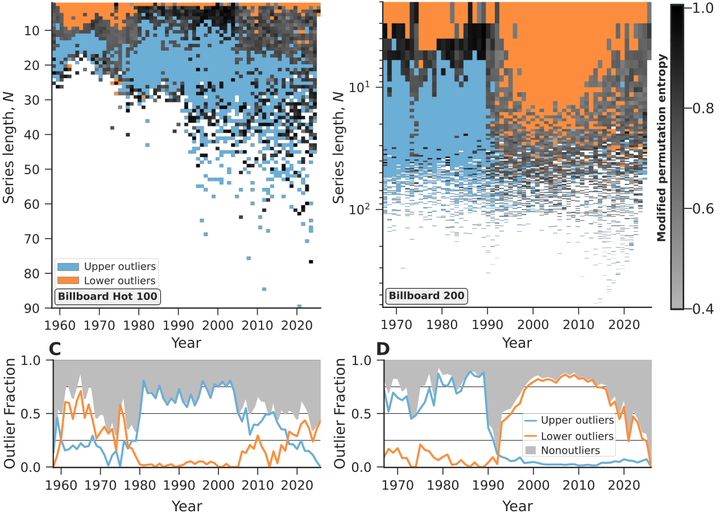
Rankings shape the visibility and success of cultural products, yet their temporal dynamics remain underexplored when comparing distinct ranked objects within the same domain. Here, we use nearly seven decades of Billboard Hot 100 songs and six decades of Billboard 200 albums to investigate how success emerges, persists, and differs between songs and albums. We find that albums exhibit a heavier-tailed permanence distribution and reenter the charts more often than songs, whereas songs typically have longer uninterrupted runs. Similarity between successive charts decays much faster for songs than for albums, suggesting that individual hits reflect shorter-lived collective attention, while albums retain longer cultural memory. Rank-turbulence divergence shows that consecutive charts are similar, but that top positions are dominated more by rank reshuffling than by turnover. Entropy-based analyses reveal high uncertainty in rank movements, with distinct historical patterns for songs and albums and a strong dependence on trajectory length. Clustering of trajectories shows that chart success is organized into a small number of typical pathways, including canonical rise-and-fall trajectories, high-end persistence, and monotonic decline. Together, these results show that musical charts are not merely records of popularity, but dynamic memory systems in which attention, turnover, and predictability interact differently for songs and albums.

Arthur Augusto Barizon Pessa
Assistant Professor

Angelo Aggio Flores
Master student